

SAF (Sustainable Aviation Fuel) is a bio-based or synthetic fuel that can be used in existing jet engines and airport infrastructure with little or no modification. SAF is a key tool in the aviation industry's strategy to reduce greenhouse gas emissions and combat climate change.
Sustainable Aviation Fuel (SAF) is an advanced biofuel that reduces carbon emissions by up to 80% compared to traditional jet fuel. Produced from renewable feedstocks such as agricultural residues, municipal waste, and non-food crops, SAF provides a practical and scalable solution for aviation sector decarbonisation.
HEFA is the most technologically mature pathway that uses waste oils or used cooking oils (UCO)/fats as a feedstock. Currently, all operational SAF facilities globally are based on HEFA.
Process: Removal of oxygen by hydrodeoxygenation → cracking & isomerisation of paraffinic molecules to jet fuel chain length.
Yield: 70–80% depending on feedstock and parameters.
AtJ involves dehydration, oligomerisation and hydro-processing to convert alcohol feedstock to SAF. Alcohols have a standard chemical formula, so feedstock variation is minimal.
Yield: ~60%, potentially 70–90% SAF with remaining renewable diesel and light ends.
Note: Scaling and integrating these processes at large scale poses engineering challenges.
FT is one of the earliest ASTM-approved routes, converting carbonaceous waste/residues to syngas (H₂, CO) and then catalytically upgrading it to jet/diesel. Certified jet specs: SPK & SKA.
Challenges: Feedstock-specific, capex-heavy, slow to build, hard to stabilize, limiting scale.
PtL combines green hydrogen (from renewables) with captured CO₂ to form syngas, then converts it via Fischer–Tropsch.
Status: Low maturity today; expected to grow post-2040 as green hydrogen & carbon capture mature.
India’s HEFA feedstocks, such as waste oils, UCO and tallow, are fragmented and complex to aggregate. India is estimated to have ~2.4 Mt UCO, of which ~65% comes from commercial sources and the remaining from households. Approximately 60% is still improperly reused and re-enters the food chain despite government disposal/collection guidelines.
Structured aggregation, quality control, and traceability can convert this fragmented model into bankable volumes to support near-term HEFA scale-up. UCO can also produce SAF via co-processing in petroleum refineries. Many oil companies in India are planning SAF production via co-processing.
AtJ can be deployed with ethanol from sugar, molasses, grains, agricultural/industrial waste, and MSW. Agri-residues are available in surplus quantity. Sweet sorghum, a sugar crop with high bioenergy and ethanol production potential, is emerging as an important crop meeting food, fodder, and fuel demands.

SAF can reduce lifecycle greenhouse gas emissions by up to 80% compared to conventional jet fuel, depending on feedstock and production process.
Scaling up SAF will require collaboration across the whole aviation value chain, including airlines, fuel producers and suppliers, policymakers, financial institutions and investors, airports, and research institutions.
ICF research shows that there are four key areas to consider, as we look at scaling the SAF industry through collaborative efforts: Policy, Economics, Technology, and Sustainability.
These areas all interact, so a holistic approach covering all stakeholders and key areas is essential. Stakeholders will also need to collaborate across this value chain.
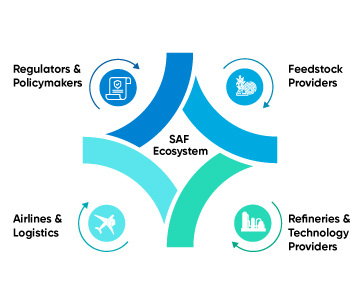
Feedstock Providers – Agricultural and waste-based sources for SAF production
Refineries & Technology Providers – Conversion of feedstocks into SAF
Airlines & Logistics – Integration of SAF into commercial and cargo flights
Regulators & Policymakers – Setting industry standards and compliance frameworks
The global SAF market is expanding rapidly, with governments and industry stakeholders investing in research, production, and supply chain development.
EU & USA – Both regions enforce strong SAF blending mandates to decarbonize aviation. The EU’s ReFuelEU initiative and U.S. tax credits under the Inflation Reduction Act support SAF deployment.
Japan & China – These nations focus on waste-based and hydrogen-based SAF production. Japan promotes advanced biofuels, while China is expanding its renewable energy-driven SAF industry.
India – India is leveraging biomass and policy support to emerge as a key SAF producer. With abundant raw materials, the country has the potential to become a global leader in SAF production.
SAF: The Key to Net-Zero Aviation
CORSIA: A Global Market-Based Mechanism
Projected SAF Demand by 2050


India is the third-largest aviation market and has the potential to become a leader in SAF production. With strong agricultural and waste resources, combined with policy support, India can achieve large-scale SAF adoption.
SAF Blending Targets – India aims for 1% SAF blending by 2027, 2% by 2028, and 5% by 2030 to support aviation decarbonization.
National Bio-Energy Mission – The mission provides policy support for biofuels, including SAF, encouraging domestic production and technological advancements.
Airline Commitments – Indian carriers are exploring SAF adoption to meet carbon reduction targets and align with global sustainability goals.
Reduces lifecycle carbon emissions by up to 80% – SAFCarbon Benefit significantly cuts aviation-related emissions compared to conventional jet fuel, aiding in climate change mitigation.
Supports clean air initiatives by lowering aviation-related pollution – SAF contains fewer particulates and sulfur, reducing air pollution and improving urban air quality.
Helps prevent stubble burning by utilising agricultural residues – By converting crop waste into SAF, it provides an alternative to burning, reducing air pollution and soil degradation.
Contributes to a circular economy by converting waste into fuel – SAF promotes sustainability by repurposing waste materials and reducing dependence on fossil fuels.


Adopting SAF benefits businesses across multiple sectors.
Regulatory Compliance – Align with international emission reduction targets
Carbon Credits & Offsetting – Generate high-quality Scope 3 emission reductions
Brand Leadership – Strengthen sustainability commitments and ESG credentials
Operational Efficiency – Reduce long-term fuel costs through SAF integration


Revolutionizing the future of aviation with sustainable innovation where cleaner skies, efficient technology, and eco-friendly solutions come together to shape a greener tomorrow.
© 2026 SAF Association. | All Rights Reserved. | Managed By Viralwebtech


